How Much to Feed a Kitten: Feeding Guide by Age
Wondering how much to feed a kitten? Here is a simple age-by-age guide for weaning, 2-6 months and 6-12 months, with meals per day and kitten foods available in Bangladesh.
Quick summary
Wondering how much to feed a kitten? Here is a simple age-by-age guide for weaning, 2-6 months and 6-12 months, with meals per day and kitten foods available in Bangladesh.
Veterinary advice notice
This article is for general pet care education only. It does not replace professional veterinary diagnosis or treatment. Consult a qualified veterinarian for your pet's specific condition.
If you have just brought home a tiny kitten, one of the first questions is how much to feed a kitten and how often. There is no single answer, because a kitten's needs change quickly as it grows. This guide explains the general stages from weaning to one year, how many meals to offer, and how to use the feeding table on the pack. It is general information only. Your vet knows your kitten best.
Why there is no one-size-fits-all amount
Kittens grow fast, so they need more energy for their size than adult cats. But the right portion depends on several things:
- Age and weight: a 3-month-old and a 9-month-old eat very differently.
- Breed and expected adult size: a Persian and a smaller street-cat kitten may grow at different rates.
- Type of food: dry kibble, wet food and milk replacer all have different energy levels.
- Activity and health: a very playful kitten may need more than a calm one.
For this reason we do not give fixed gram amounts here. The safest starting point is the feeding table printed on the pack. Kitten food makers base it on the weight and age of your kitten. Then adjust slowly with your vet's advice.
Stage 1: Newborn to weaning (about 0-4 weeks and the weaning period)
Very young kittens depend on their mother's milk. If the mother is not available, they need a proper kitten milk replacer, fed exactly as the product instructions say. Ordinary cow's milk is not a good substitute and can upset a kitten's stomach.
Weaning usually begins at around four weeks. It is a gradual change, not a sudden one:
- Offer a little soft wet kitten food, or kitten kibble softened with warm water, on a shallow plate.
- Let the kitten lick and explore. It will be messy at first.
- Slowly reduce milk feeds as the kitten eats more solid food.
- Keep fresh water available once the kitten starts eating solids.
During weaning, meals are small and frequent. If a kitten refuses food, seems weak or has watery stools, call a vet the same day. Young kittens can get into trouble quickly.
Stage 2: 2 to 6 months
This is the fastest growth period, and kittens usually need several small meals a day. Three to four meals is a common pattern, but follow your vet and the pack. Small, regular meals are easier on a young stomach than one or two large ones.
- Choose a food labelled for kittens (or growth). It is made for growing bodies.
- Check the feeding table using your kitten's current weight, and recheck it as the kitten grows.
- Mixing dry and wet food is fine for many kittens. If you do, count both toward the daily total instead of feeding the full amount of each.
- Change foods slowly over about a week, mixing the new food with the old, to avoid tummy upsets.
Dry, wet or both?
Dry food is convenient and easy to measure. Wet food adds moisture and is often tastier for fussy kittens. Many owners use dry food as the base and wet food as a meal or topper. Pouches are handy for single meals, while cans suit multi-cat homes if you store the leftovers in the fridge.
Stage 3: 6 to 12 months
Growth slows down, and many kittens move to two or three meals a day. Kittens at this age can become heavy if fed freely, especially after neutering, when energy needs can change. Ask your vet when to start spaying or neutering and how to adjust food afterwards.
Most cats are moved to adult food at around one year, but larger breeds may stay on kitten food a little longer. Your vet can tell you when to switch. Do this gradually too.
Quick guide: age, meals and what to watch
| Age | Typical meals per day | Main points |
|---|---|---|
| Up to about 4 weeks | Mother's milk or milk replacer, as directed | Follow the milk replacer label closely and ask a vet if unsure |
| 4-8 weeks (weaning) | Small, frequent meals | Introduce soft kitten food gradually |
| 2-6 months | Usually 3-4 small meals | Use the pack's feeding table by weight |
| 6-12 months | Usually 2-3 meals | Watch body shape, especially after neutering |
These are general patterns, not strict rules.
How to know if the amount is right
- Body shape: you should feel the ribs under a thin layer of padding, and see a slight waist from above.
- Energy and coat: a healthy kitten is playful, with a clean coat.
- Stools: soft but formed. Ongoing loose stools need a vet visit.
- Weight: weigh your kitten regularly and compare it to the pack table.
Remember that treats count too. Give them sparingly and check the pack for the suggested age. Most of the diet should come from complete kitten food.
Kitten foods available at JUST PET BD
Here are some kitten foods in stock. Prices are JUST PET BD prices in November 2026 and may change.
| Product | Type | Price |
|---|---|---|
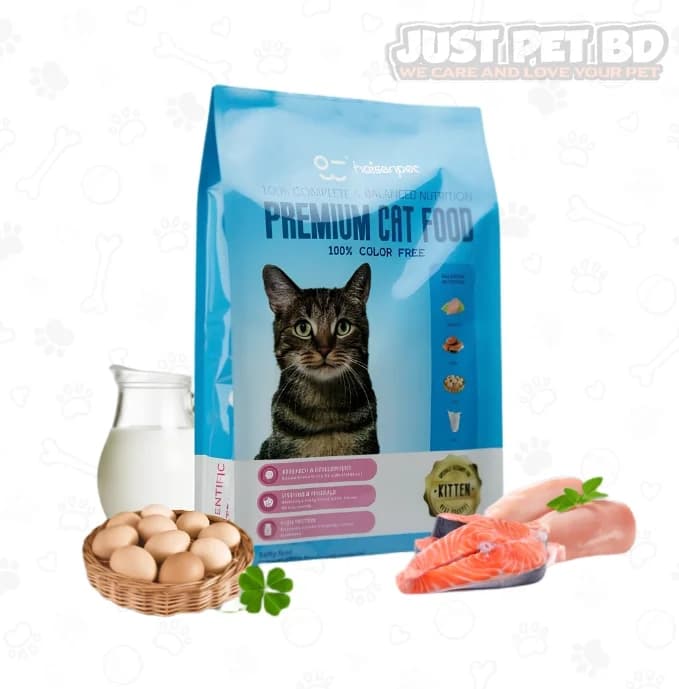
| Haisenpet Premium Kitten Dry Food 450gm | Dry | ৳270 |
| Lara Junior Dry Cat Food, Chicken (350g) | Dry | ৳280 |
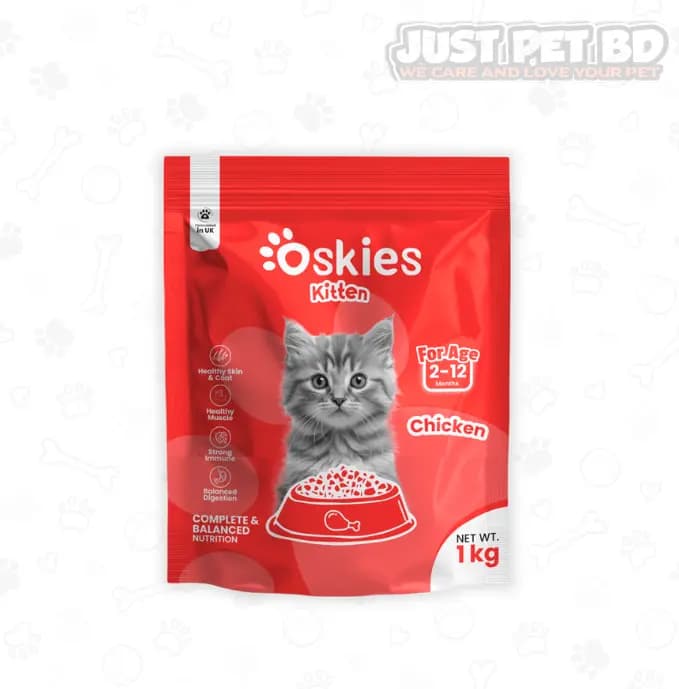
| Oskies Kitten Cat Food Chicken 1kg | Dry | ৳320 |
| Smart Heart Kitten Food 450g | Dry | ৳340 |
| Jungle Kitten Dry Cat Food Chicken 500gm | Dry | ৳350 |
| Trendline Chicken Kitten Dry Food 1kg | Dry | ৳480 |
| Jungle Junior Kitten Cat Food 1.5kg | Dry | ৳800 |
| Reflex Plus Kitten Cat Food Chicken 1.5kg | Dry | ৳1050 |
| Smart Heart Kitten Wet Pouch, Tuna in Jelly 85g | Wet pouch | ৳80 |
| Purina Felix Kitten Pouch, Chicken in Jelly 85g | Wet pouch | ৳110 |
| Wanpy Kitten Canned Food Chicken & Tuna 375gm | Wet can | ৳180 |
| Cango Chicken Recipe Kitten Wet Food 415g | Wet can | ৳185 |
Larger packs such as the Smart Heart Kitten Food 2.8kg (৳1550) or Haisenpet 3kg (৳1350) can suit homes with more than one kitten. Make sure you can use the food while it is fresh. Browse more in Kitten Food or Cat Wet Food.
Practical feeding tips
- Use a clean, shallow bowl. Our cat feeding tools can help.
- Always keep fresh water near the food.
- Store dry food in a sealed container, away from heat and humidity.
- Throw away wet food left out for too long, and refrigerate opened cans in a covered container.
- Keep to a routine, so your kitten knows when meals come.
বাংলায় সংক্ষেপে
বিড়ালছানাকে কতটুকু খাবার দেবেন তা নির্ভর করে তার বয়স, ওজন ও খাবারের ধরনের ওপর। ছোট বয়সে অল্প অল্প করে দিনে কয়েকবার, আর বড় হলে ধীরে ধীরে বার কমিয়ে আনুন। প্যাকেটের ফিডিং টেবিল দেখুন এবং কোনো সমস্যা হলে পশুচিকিৎসকের পরামর্শ নিন।
Ready to pick a food for your kitten? Order on justpet.bd from our Kitten Food collection. We offer cash on delivery and bKash/card payment, with delivery all over Bangladesh (inside Dhaka ৳70, outside Dhaka ৳130).